- Home
- Products
- Electric Wire and Cable
- Optical fiber
- Optical fiber application products
- Oil leak detection optical cable
Optical fiber application products
Oil leak detection optical cable

Overview
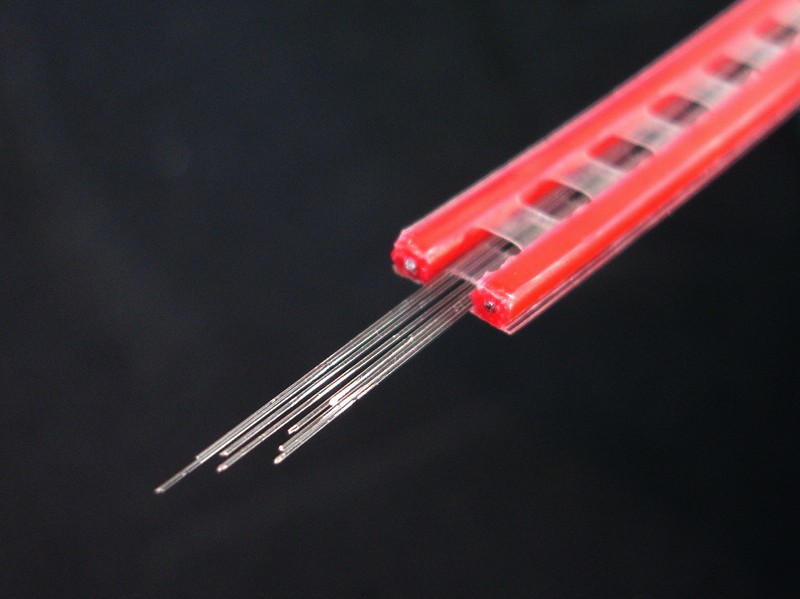
The surface of the optical fiber is specially processed to detect oil, etc., and when oil adheres to it, the light intensity attenuates, detecting oil adhesion.
The entire length of the optical fiber is specially processed in this way, giving it a structure that reacts to oil no matter which part of the fiber it adheres to. (Patented)
Features
- Reacts to liquids with a high refractive index (1.46 or higher) such as heavy oil and gear oil.
- Since no electricity is used for the sensing, it can be used safely for liquids at risk of igniting.
- A key feature of the optical fiber system is its instantaneous change in light intensity when oil adheres to it.
- Maximum fiber length is 50 m, the whole length of which is treated for sensing.
- If contamination (oil adhesion) is minor, the fiber can be cleaned and reused.
Main applications
- Anywhere you want to detect fuel or lubricating oil leaks, such as storage facilities and tanks, around motors, and at conveyor pipe joints
- Hazardous locations or facilities where electric sensors cannot be used
- When it is difficult to identify the scale or location of an oil leak and you want to sense over a wide area
Structure (Principles)
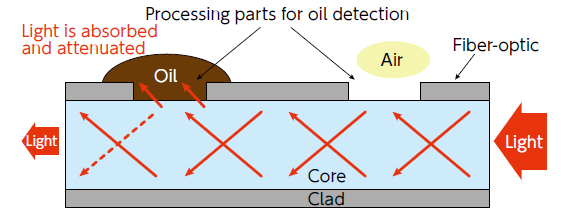
The surface of the optical fiber is specially processed to react only with some liquids with a high refractive index (1.46 or higher) such as oil, without reacting to air or water. When oil, etc. adheres to this surface, the light intensity
instantly attenuates, indicating the presence of oil.
This specially processed surface extends along the entire length of the fiber,ensuring it reacts regardless of where the oil makes contact.
Specifications
| Optical fiber type | HPCF |
|---|---|
| Core diameter / materials | 200 μm / quartz glass |
| Clad diameter / materials | 230 μm / UV resin |
| Number of fibers | 8 standard (TBD) |
| Protective cables/materials | 2.5 × 8.0 mm / PE resin |
| Light intensity change rate with oil adhesion |
5% or more (at 1 cm length adhesion) |
|---|---|
| Recommended light source | LED (λ=820 to 920 nm) |
| Allowable bending radius | 150 mm or more (small diameter direction) |
| Cable length | Maximum 50 m |
Model no.
| For 8-core - 50 m (example) | OLM-H08-50M |
|---|
- * : This product is sold only as a stand-alone sensor cable.
For requirements involving sensing devices,please contact us separately.
- Inquiries regarding materials, consultations, and technology
- Inquiry from Web: Inquiry form